Anyone who needs real conditional logic (not just a relay or a single-function timer) to automate a sequence of on/off actions, without paying the hundreds or thousands of dollars a traditional industrial-brand PLC costs, or depending on a distributor that doesn't sell on Amazon — also a solid pick for learning ladder logic from zero thanks to the included course.
PLC
Ladder Logic
DIN Rail
What is it and what's it for?
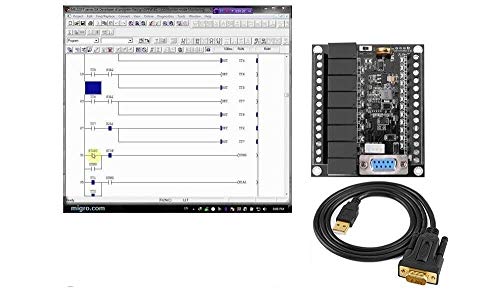
A plain relay only does one fixed thing (close a circuit when it gets a signal); a PLC is different — think of it as an employee who follows a list of rules all day long, "if this happens, and also this other thing, then do that," without ever getting tired or skipping a step. Those rules are written in "ladder logic," a visual language that looks like a diagram of switches in series and parallel, designed so someone without a programming background can read and build it. This particular kit is the small, affordable version of that idea: a board with 12 inputs (for sensors, buttons, limit switches) and 8 relay outputs (for small motors, valves, lights, solenoids) that you program once from a PC over USB and then let run on its own, no PC attached.
Real-world use cases
At home
In a greenhouse or a home hydroponics setup with several pumps and lights, instead of wiring a separate timer for each function, you program one set of rules (for example: "if the level sensor reads low AND it's daytime, turn on the irrigation pump, but never at the same time as the grow light if they share the same circuit") — exactly the kind of conditional logic a simple timer can't do on its own.
In a business or workshop
In a small workshop or a simple production line, it's used to sequence a conveyor's start-up with safety interlocks (it won't start if a guard door is open, it stops if a sensor detects an obstruction) without needing a high-end industrial PLC or an integrator billing for the whole project — more than enough for a process with just a few variables.
How to avoid buying the wrong one
The programming software runs on Windows 10 32-bit — it may not install directly on a modern 64-bit Windows 11 PC; confirm you have (or can get) a compatible machine before buying if you're not comfortable running legacy software in a virtual machine.
It has no RS485/Modbus port: it doesn't join this catalog's Modbus RTU relay bus or a centralized SCADA system — its 8 relay outputs are the only way it controls equipment, wired directly.
Only 4 reviews on Amazon despite the 4.7-star rating — a real but very short track record; if you're going to rely on it for anything critical, it's worth keeping a simple backup relay on hand while it builds up more history.
The investment takeaway
Compared to building the same logic out of loose relays and timers (which turns into a wiring mess as soon as there are more than two or three conditions to combine), or jumping straight to a several-hundred-dollar industrial-brand PLC that also demands separate training, this kit gives you real ladder logic, its own power supply, a DIN rail, and an included training course for $149.97 — the investment pays for itself the first time you need to change a rule in the sequence without rewiring anything, just reprogramming it over USB.
Migro PLC Ai Kit — Mini Programmable Logic Controller 20 I/O, with Software and Ladder Logic Course Included
Supports all three serial standards (RS232/485/422) on one device, so it works for both old instruments with an RS232 port and multi-device RS485 buses. PoE power is a real plus in installations where there's no outlet near the panel — a single Ethernet cable carries both data and power. Confirm whether your Modbus master needs TCP Server or Client mode before buying; the mode is set in software, it doesn't come fixed from the factory.
Single-phase input to 220V three-phase output — the typical choice for workshops without a three-phase feed that want to run a 3-phase motor. This is an entry-level model (2HP/1.5kW), meant for spindles and small CNC motors, not large industrial loads. The output range up to 3000Hz is only useful if your specific spindle takes advantage of it — for a standard 60Hz motor it's irrelevant.
Has vector control (not just scalar V/F), which holds torque better at low RPM — important if you'll be threading or cutting at reduced speed. At 5HP/4kW it covers larger motors than the entry-level model, and accepts both single-phase and three-phase input, giving flexibility depending on the electrical setup available. Rated up to 26A — confirm your wiring and breakers can handle that current before installing.